
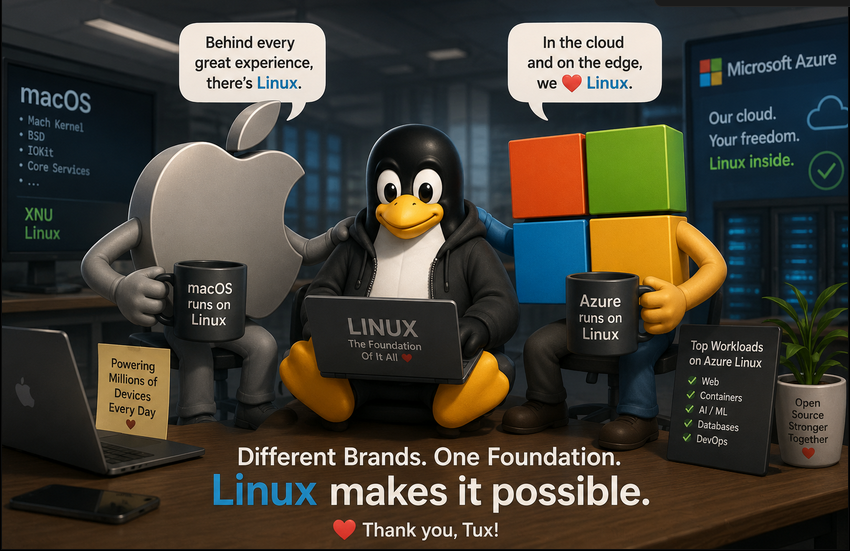
Apple and Microsoft both compete with Linux in some areas, but they also depend on Linux because it has become the foundation of much of the modern computing infrastructure. “Depend” doesn’t mean their products require Linux to work—it means they rely on Linux in many parts of their businesses.
Here are the main reasons:
- Cloud infrastructure
Both companies run massive cloud services, and Linux is the dominant operating system for servers.
Microsoft runs a huge percentage of workloads on Linux in Microsoft Azure. Microsoft has publicly said that more than half of Azure virtual machines run Linux.
Apple uses Linux extensively in backend infrastructure for services like iCloud, Apple Music, and App Store operations, although it also uses other Unix-based systems.
Linux is popular because it is:
- Stable
- Highly scalable
- Efficient
- Free to modify
2. Software development
Many developer tools are built for Linux first.
Examples include:
- Docker containers
- Kubernetes
- Git
- PostgreSQL
- Redis
- TensorFlow
- PyTorch
Developers at Apple and Microsoft use Linux systems for building, testing, and deploying software.
- Artificial intelligence
Most AI training happens on Linux.
Frameworks like:
- PyTorch
- TensorFlow
- CUDA (NVIDIA)
are primarily developed and optimized for Linux. Microsoft’s AI services and Apple’s internal AI infrastructure both benefit from this ecosystem.
- Open-source ecosystem
Linux is the center of one of the largest open-source ecosystems.
Both companies contribute heavily to Linux and related projects:
Microsoft is one of the largest corporate contributors to the Linux kernel and maintains many Linux tools.
Apple contributes to numerous open-source projects that interact with Linux, although its own operating systems are based on BSD rather than Linux.
- Containers and Kubernetes
Modern applications are often packaged as containers.
Containers are designed around Linux kernel features such as:
- namespaces
- cgroups
Even on Windows and macOS, Docker often runs a lightweight Linux virtual machine behind the scenes.
Apple doesn’t use Linux for macOS
This is an important distinction.
macOS is based on the Berkeley Software Distribution (BSD) Unix family, not Linux. Its core, XNU, combines components from the Mach microkernel and BSD. So your Mac isn’t running Linux.
Microsoft doesn’t use Linux for Windows
Windows has its own kernel.
However, Microsoft has embraced Linux by:
Creating Windows Subsystem for Linux (WSL), which lets users run Linux environments directly on Windows.
Supporting Linux extensively on Azure.
Shipping Linux-based tools for developers.
Contributing code to the Linux kernel.
In short
Neither Apple nor Microsoft “depends” on Linux to build their desktop operating systems. Instead, they depend on Linux because it has become the standard platform for:
- Cloud servers
- Containers
- AI and machine learning
- DevOps tooling
- Internet infrastructure
Today, much of the internet runs on Linux, so even companies with their own operating systems rely on it to power the services behind their products.
by: ChatGPT