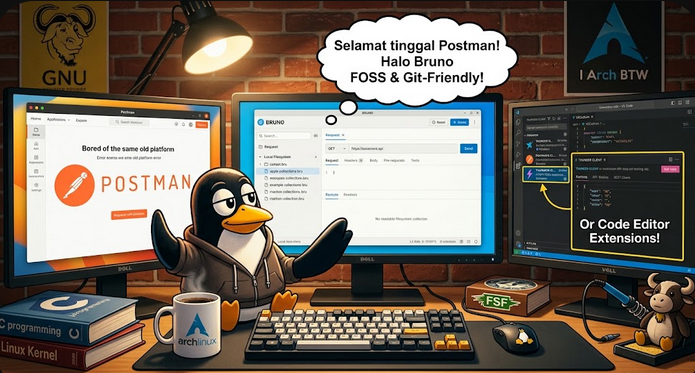
For years, Postman was the undisputed king of API testing. However, recent shifts toward mandatory cloud synchronization, forced account logins, and heavier software footprints have left many developers feeling frustrated. If you work in a high-security environment, travel frequently, or simply value your data privacy, you need tools that respect your workflow.
If you are looking to take back control of your data, here are the best open-source, offline-first, and VS Code-integrated alternatives to Postman in 2026.
- Bruno: The Open-Source, Git-Native Revolution
Bruno has completely redefined how developers think about API collection management. Built strictly to counter the “forced cloud” trend, it operates with a completely local-first mentality.
How it works: Instead of storing your collections in a proprietary cloud database, Bruno saves them directly to your hard drive as human-readable plain text files using the .bru markup language.
- VS Code Extensions: Zero-Context Switching
If you want to keep your development workflow lightweight, you don’t even need to install a separate desktop application. You can turn VS Code into your ultimate offline API testing ground.
- ⚡ Thunder Client
While Thunder Client transitioned its advanced team features to a closed-source paid model, its core extension remains one of the fastest, most intuitive ways to test APIs inside VS Code. It stores all data locally in your workspace, giving you a clean, lightning-fast UI without forcing you to switch windows.
- 📁 Rest Client (The Ultimate Open-Source Minimalist Choice)
If you want a purely open-source, code-based approach inside VS Code, Rest Client is a legendary extension.
How it works: You create a simple plain text file with a .http or .rest extension and write your requests directly in text format (e.g., GET https://example.com). The extension adds a small, clickable “Send Request” button right above your text. It is entirely offline, incredibly fast, and effortlessly tracks via Git.
3. Insomnia: The Clean, Open-Source Compromise
Maintained by Kong, Insomnia is historically the closest direct visual competitor to Postman. After facing heavy community backlash for attempting to push mandatory cloud accounts, the developers listened to the open-source community.
Insomnia has fully returned to supporting a local-first, account-free setup out of the box. It is completely open-source (Apache 2.0 license) and offers robust, offline capabilities for managing highly complex REST, GraphQL, and gRPC requests. If you want the slick, feature-rich interface of Postman without your data leaving your machine, Insomnia is an excellent fallback.
Summary: Which One Should You Choose?
| Tool | Deployment | Open Source? | Best For |
| Bruno | Desktop App | Yes (MIT) | Teams wanting Git-driven collaboration and offline safety. |
| Thunder Client | VS Code Extension | No (Proprietary) | Developers seeking a fast, graphic UI inside their editor. |
| Rest Client | VS Code Extension | Yes (MIT) | Minimalists who want to write raw HTTP requests in plain text files. |
| Insomnia | Desktop App | Yes (Apache 2.0) | Users who want a Postman-like experience but purely offline. |
Conclusion
Moving away from centralized cloud tools isn’t just about avoiding subscription fees—it’s about data sovereignty, privacy, and speed. By adopting open-source and offline-first tools like Bruno or VS Code extensions, you ensure that your API testing suite remains private, fast, and entirely under your control.